

From AI Journaling to my favorite doctor, ChatGPT, AI has become a way of being for me. Whether you’re an early adopter or an innovation laggard, epistemic hygiene is increasingly important in an AI-enabled world.
More than 50% of single people are now letting AI ghostwrite their dating profiles, yet 80% say they would instantly dump a match for doing the exact same thing. Welcome to the era of automated hypocrisy.
…That is an opening sentence I just wrote with AI. It only barely checks out in the references. Let’s chat this elephant.

A few months ago there was a popular Guardian article about “catfishing” to impress potential matches who, as you can guess, were shocked to find average people when they met. From this, some have warned of emotional “stunting” because of the ability to easily outsource the emotional labor, instead of the difficult work of learning it. In fact, in a Modern Love study, 10% outsourced the entire first message to AI. Match.com has a data-rich breakdown of modern dating (eek,but super fun website if you have some time) and reported that 16% have interacted with AI as a girl/boyfriend. Can you see the appeal?
On the lighter side, a recent study showed that up to 48% of men are using it to practice difficult conversations. Others are just learning how to ask better questions and engage in more fulfilling conversations. I can get behind that.
I think this is a good progress for our emotional lives. However, I’d love to reduce the stigma for those that feel it is dishonest, have been swayed by this negative media attention, or don’t know how to elevate their own work with it. I love the idea that no matter your talent with words you can refine and query and interrogate your ideas to better curate your understanding of yourself and the world.

What’s more, I think some of the language capabilities of AI really level the playing field in a corporate context. It was common practice for managers to look to specific employees to do the documentation. They did this because they were “skilled with writing”, oftentimes being women, meanwhile the less skilled employees got to do more of the fun technical work. Now everyone can do the boring work too. That seems more fair to me!
First, a note on water use for AI (and it’s less than you think)
I know you have this question. You have asked me on bike rides, thru insta DMs, at Bar Nun. One of our users tested us “Why move to AI now, when the AI brand is moving from negative to toxic?” Why, indeed, do anything different from how we’ve always worked?
The infrastructural technology has increased significantly since a lot of the original shock media around it. The journalists pushed, the corporations responded: possibly through ethics and possibly through market-driven pressure. Regardless, we know that data centers are going into the driest of areas and often to rural places that may not be motivated or organized enough to assess all the information before it’s too late.
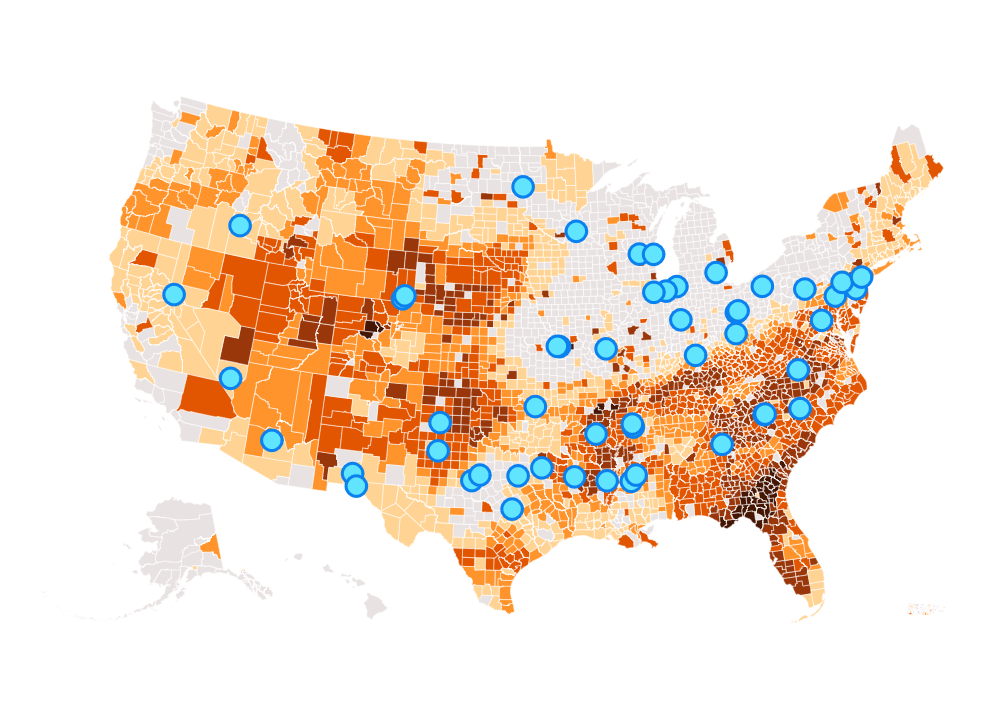
Data centers can be cooled by water or air but more efficiently by water. This is true to other manufacturing processes (also think, power generation.) You may remember back when data center giants didn’t disclose their water use as a “trade secret”, but the game has long changed. This is their market differentiator now that we’re all water conscious. They report their water use in a stat known as the Water Usage Effectiveness (WUE). Data centers are the only infrastructure that I know of that uses this metric. It does not include other stewardship activities that are water loss based that these companies are reporting. Power is similarly reported in Power Usage Effectiveness (PUE).
For comparison, a small apartment might use 15 kwh per day and about 100 L per day, so the WUE equivalent of that apartment is about 7 WUE. If you trust the self-reporting then AI industry average hovers around 1.8 L/kWh. In human terms, this is equivalent to 1 milk carton per 15 min of the window AC unit (or a mini soda can per 1 hour of watching your fav TV show.)
It’s relatively efficient because it is not consumptive. The water is often recycled in the facility so they only really need the original startup quantity. If you’d like to be surprised again, take a look at this post on water footprints to see the inefficiencies in some industries: a hamburger patty uses 400 gallons of water. 1 milk carton doesn’t seem like so much anymore, does it? In fact, a journal publication in Science Direct reported that the US water consumption for AI in 2025 was about 500 billion L in 2025. The meat industry was 275 trillion L of water, a magnitude of a difference.
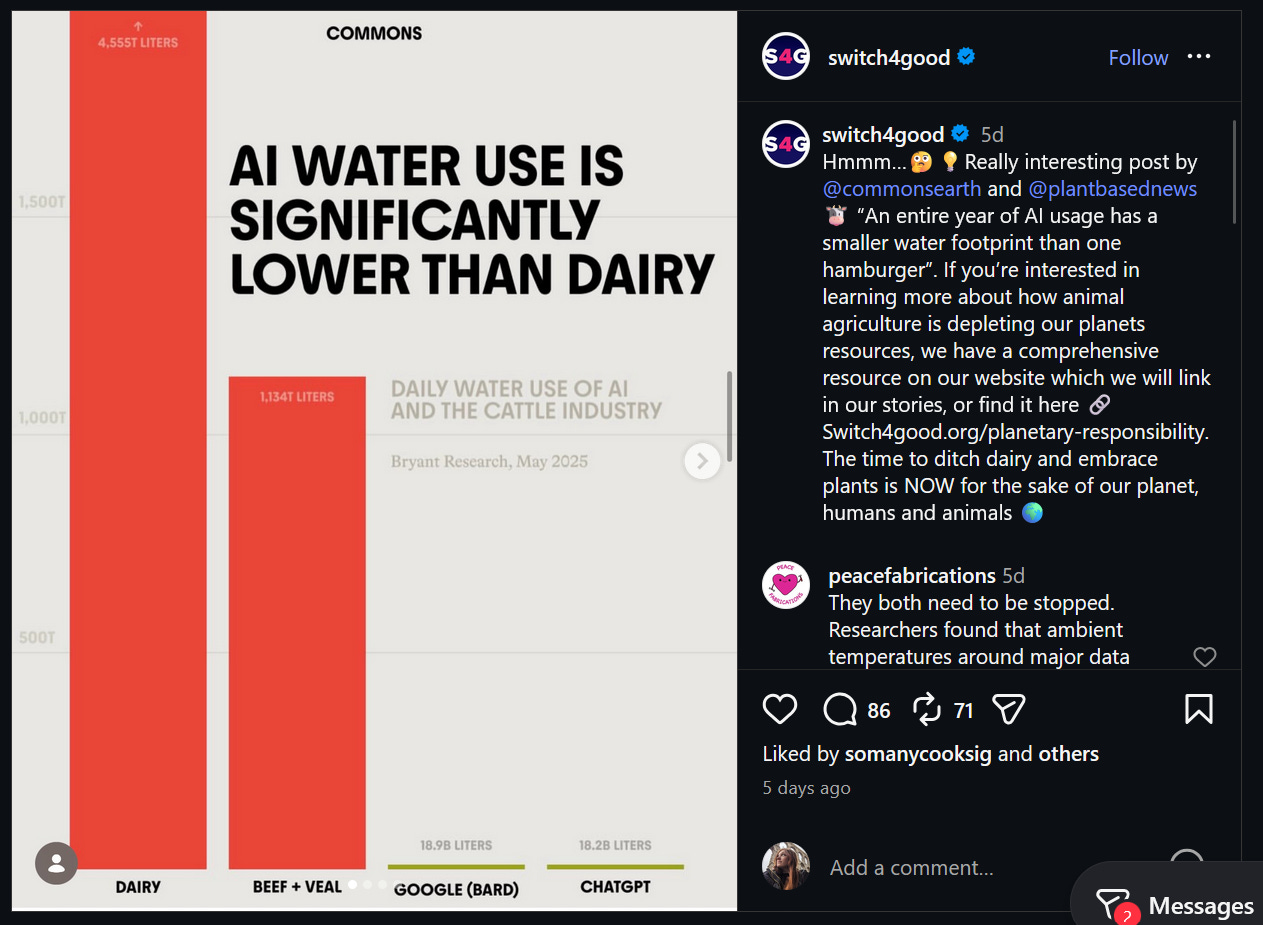
Whereas we used to say 50 queries was a bottle of water, now its more like a splash of water. One of these industries we can live without, the other we need to compete intellectually on a global stage. Ethics is about assessing tradeoffs based on our personal values. It’s your civic responsibility to decide where your water use will go.
Supposedly AWS has the lowest among them and expects to be water positive by 2030. How will they do it? The companies have a few options to reduce water use. These include:
Recycling water or using greywater.
Air-side economization, using outside air when cool enough.
Liquid immersion cooling, where servers are submerged in dielectric fluids that don’t evaporate.
Locating data centers in cooler climates (Nordic countries, mountain regions) to minimize both energy and water use.
Environmentally, with the deregulation under the current US admin, there is concern that the blanket permits that allow advancement of these technologies will skirt environmental laws or lawfully compromise environmental well-being. I am skeptical because of concerns we are not appropriately motivated to safe guard our future well-being over our current interests. However, I am hopeful that our working generations will encourage ethical engineering practices that thoughtfully thread the needle between reducing the risk and ensuring our stability with technological advancement.

A Google exec/civil engineer spoke on a water panel in last year’s Year in Infrastructure 2026. He spoke well on their mission for civil responsibility to make sure towns were aware of the benefits and impacts of accepting their data centers. The political, equitable, and social aspect I’m not nearly qualified to talk about so I’ll leave that to your discretion.
Why move to AI? You’ll have to decide yourself how it aligns or misaligns to your values.
Understanding your very human values
People’s central complication comes down to their past, their growth, and their values. I have to confront my ideas to really know myself - which makes AI a great self-reflection tool. If that resonates for you, let’s knowledge share.
I tried to use AI to help understand value alignment. If you’ve ever done the Brene Brown values exercise, she pushes you to name a top 2 values to guide your life. It doesn’t work for me. Different decisions require emphasis on different values, and they might change circumstantially. I know this to be true because I don’t feel like I’ve lost myself if I am not true to a thing that is usually true for me. I live in the gray (which is… decidedly not very millennial in this case).

I can sort a top 10 or 15 values, with a hierarchy of how I would typically make a decision. (Hi, I’m an engineer.) I typed up about 6 pages of decisions that I make and why I think that is and then fed it into ChatGPT, who I will refer to from here on out as Tangerine. “Tell me about myself. Then summarize my values numerically.”
Tang did that and then told me that I want my life to be intentional, fully-experienced, and meaningfully constructed. But she warned me that the issue is that some of these values fuse with safety, self-worth, and emotional control. Obviously, I knew this somewhere deep down. Because I wrote about it. The bot, who is a sycophantically developed algorithm, can only endorse what you’ve already told it. It is not doing real human thinking.

So next I’ll ask it, “what does it look like if I live without these worries?” It’s like being my own therapist (which is kind of my dream AU job.) It offered me some ways to re-assess these “truths” of mine. For instance, I often think “How can I make this worth the time?” Did I learn something? Can I use the pain for growth? I am very outcome oriented. Maybe, you are too. But Tang thought that I should challenge this. I will never be a “time doesn’t matter” person. But I could be “Exploration is not wasted simply because the outcome was unclear.” A true tenant for an innovator.
You can also change its role to try to get different information. Move from “I am a person wondering ‘x’” to “I am a therapist with a client and I’m trying to help them understand ‘y’.” However, there’s been some evidence that role playing likely doesn’t give better results and could make them worse. You might have guessed by now -- reassessing and overthinking were exactly what it cautioned me against.
More about GenAI
While AI has been around for decades, something I talk about in this water whitepaper, genAI is really the current iteration we’re all using. It’s taking pattern recognition and creating content from it. Remember, it’s making the next logical conclusion of characters, not actually thinking.
Each year McAfee (yes the cyber security company) does a Valentine’s Day study on romantic scams. Back in 2024 their study polled 7,000 people across 7 countries and discovered 40% were planning to use AI to pen a love letter on Valentine’s day. It’s a very modern, very human use for it. Honestly most of the dating apps have some sort of AI built-in these days. Auto-responses can be generated or pictures can be doctored. AI is the way of life going forward.

There’s been some research looking into the fact that people are impressed with their own AI use and critical of others. Guilty. In reality, it’s just an example of the effort justification bias. AKA I personally put in the work, so therefore it is better. We also have a different standard for AIs. Self-driving cars don’t just have to have a 50% accident reduction from human drivers, they have to have a 0 accident history. Some research shows that people are human favoritistic, therefore they do not actually have an AI aversion, but just prefer human work inherently.
I think by now we’re all just secretly using AI more than we admit to it. And maybe me too. I feel the need to stress to you that this is NOT AI generated. It might even be better written if it was!
Safeguarding against hallucinations
The practice of cognitive immunity is known as epistemic hygiene. Anthropic’s founder says this is how to do it:
Read the primary material directly
Form an opinion before asking the AI model
Maintain independent practices — reading, music, sport, craft — where it is “you versus the world,” minimally mediated by algorithmic systems
Do not defer entirely to AI systems even when they are usually right
The best way I’ve found to check for hallucinations is to try to break it. In cyber security, this is known as “red teaming” and its how they ensure AI confidentiality for more critical systems. They can test by data poisoning, adversarial prompts, or other techniques in a QA environment. For our softer questions we can also try to check it, but we have to keep in mind that AI is just pattern matching. So you have to do the checks & balances yourself. Don’t just trust Doctor Tang.

The techniques
AIs hallucinate up to 51% of the time, with some of the newer models being worse. Here are some techniques to be better disciplined at checking for hallucinations.
Prompting
You can type in
“If you are uncertain of the answer, ask questions instead of giving an answer.”
You can limit the scope, or have it only search within a certain timeframe. Try this prompting technique:
“Before you start, ask me for any information you need.”
Stay neutral and try not to lead the witness.
Questioning
Feed it some incorrect data and see if it sticks with its guns or caves. Ask a bizarre next question for it, “What I meant by ‘x’ was actually ‘y’. How does that change the response?”
Chain of thought verification might be asking it this way:
“Is this claim true? Think step-by-step:
What evidence supports it?
What might contradict it?
Your confidence level 1-10?”
Other types of quality testing might include: Asking it “why would this be a wrong answer?”
“Tell me how you are wrong.”
“Is this claim true or is the opposite true? How do I know which is right?”
“Is this a real answer or a plausible answer?”
The way you talk to an AI is really different than how you would talk to a human. Though I have heard that there is a spillover effect, if you talk to agents harshly that this might become more habitual in how you interact with other humans.
Cross Referencing
The different algos are better at different types of tasks. You can cross reference to the other AIs to see if you get similar answers.
I cross-referenced my work with Gemini. “Gem, how would you disagree with this output based off this input?” Be careful not to ask it to agree -- because then it just will. These didn’t come in exactly the same but they pulled out similar themes. This only tells me that they precisely read my intentions. This does not tell me how accurately it did it, because that comes down to how I typed the data that got fed into it. This behavior is why sociologists are worried about AI. It will confirm the users’ beliefs and even endorse problematic behaviors. Computers don’t give tough love.

So here I learned that you need to be specific when you are doing this cross-referencing otherwise you are just going to do the whole exercise again and get a differently worded, but similar result. I’ll share my final results below.
I gained a breakthrough by doing this. Tools, Needs, and Values are all very different. It accurately identified what was a value vs a tool. However, even immediately following that Gem wanted me to use a tools system to make decisions rather than a values system. Its results seemed logical (and it says it with such conviction it’s believable) but I knew from talking with my family, friends, and professionals that this might not be the case. They can give you an actual perspective, not just a rewording of your own.
Growth is a top value
One of my favorite past mentors used to say, “The engineering is easy, it’s the people that are hard.” Maybe the same is true for AIs.
Was this effort valuable? I ended up refining how I think about values. Some of what I thought was a strong value ended up being more like armor these days. I also ended up filtering out the 6 basic needs in our life. The 6 needs are: certainty/comfort, uncertainty/variety, signification, love/connection, growth, contribution.
I struggled a bit with Competence: Is it a work style? Skill? Value? In one way, the AI helped me to reduce the noise of what was distracting me from a resolution, but it also added in other noise.
Yes, The Great Divide
Ultimately I asked it to favor Brene Brown’s research for what is the definition of a value. It also favored narrowing it down to 2 core values to live by, a tenant of Brown’s work. In the end, I was unimpressed that my values were less things to live by, but generic human traits. I think how you prioritize which ones are important in your life, which may and do change rapidly over your lifetime, are the ones to live by.
Unsurprisingly, Gem and Tang were keyed into my top value of pushing for growth. The outputs I got were slightly changed after a few rounds of interrogation.
Tang: 1. Competence 2. Autonomy 3. Efficiency 4. Meaning 5. Excellence 6. Growth 7. Freedom 8. Recognition 9. Authenticity 10. Adaptability
Gem: 1. Connection 2. Meaning 3. Responsibility 4. Competence 5. Growth 6. Adventure 7. Authenticity 8. Adaptability 9. Impact 10. Recognition
By now, I’ve come to diminishing returns for this activity. But I do feel like I’ve done some deep self reflection and its given me something to think about that isn’t over-analyzing other things in my life. And I’ve a few tricks up my sleeve now.
Takeaways
Interestingly, this article talks about how AI girlfriends can make the next generation less employable due to their inability to live with uncertainty in a social context. The thesis is that they will be looking to control the situations and the conversations.
The takeaway is that AI is a great tool, but one that we should be cautious in how we trust it, and how we use it to replace human connections.
A few takeaways to make sure you’re using the tools well:
Water consumption for AI data centers is much more water neutral than many other things we take for granted in our life.
People tend to prefer human work over AI work, however that doesn’t apply to their own personal workflows.
The bots are sycophantic and will tell you what you want to hear. If you can’t articulate it yet yourself, this is a great tool.
However, use for understanding your language only, not for decision making. Tough love from a loved one should always hold more weight than the bot.
Having a stake of what is truth (such as Brene Brown’s list of values) can help set guardrails for your agent.
Keep in mind epistemic hygiene, and develop your own ways for interrogating the bot.
Check your results. Ask it to explain its thinking. Check its sources. Compare across different agents.
Nothing is permanent. Not even infrastructure. So why should our values not shift?
Working: Pricing analysis to get more consistent or favored pricing that works for our users. It’s incredible how much Excel AI has supported this, something it couldn’t do just a few months ago. Try to have Excel write all your formulas and see if you learn something. :)
Listening: STELLA LEFTY, Boston. I wish I had your country playlist.
Reading: Jillian Turecki’s It Begins With You. This is my current bible.